The word occult comes from the Latin occultus, meaning “hidden” or “secret,” and that idea sits at the heart of Occult Symbols You Should Know. They represent knowledge believed to be concealed from ordinary understanding—things like cosmic secrets, alchemy, and forbidden rituals. Over the centuries, these symbols have acted like coded messages, using simple shapes and strange diagrams to hide deeper meanings.
A triangle, a circle, or a square might look basic, but in the world of Occult Symbols You Should Know, each carries layers of symbolism meant only for those who know how to read them. From alchemical emblems like the squared circle to mystical diagrams passed down through secret traditions, these symbols have quietly preserved hidden knowledge for generations.
The All-Seeing Eye
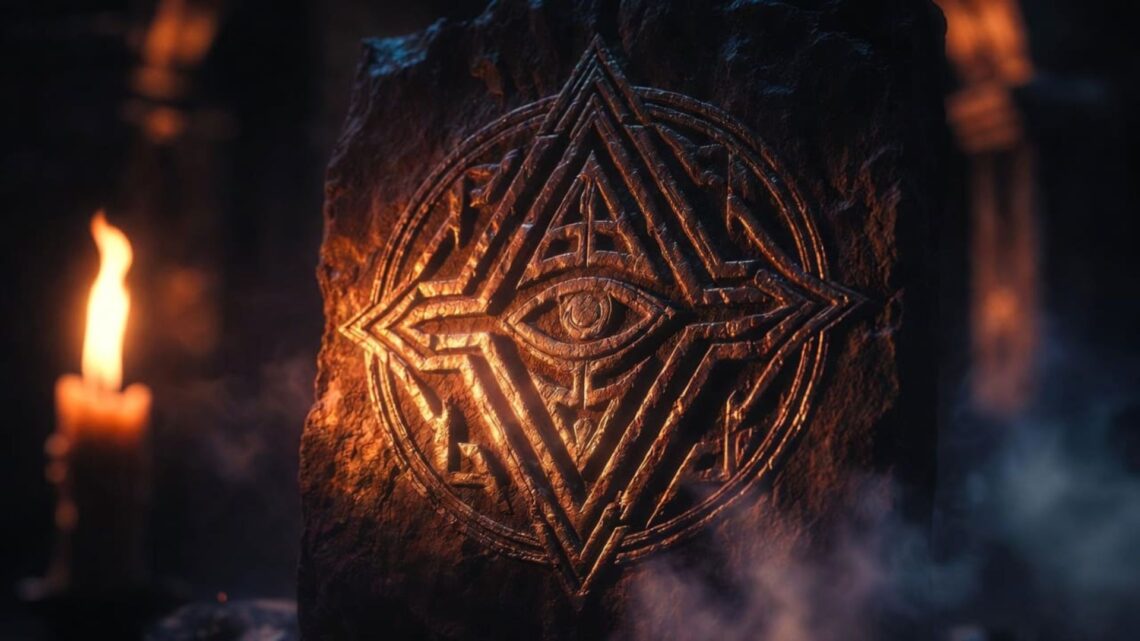
Alright, everyone has seen this one somewhere. The All-Seeing Eye. Eye of Providence. Whatever you want to call it. Basically, it’s an eye that sees everything. Omnipresent, all-knowing, kinda creepy if you think about it. It’s on the U.S. dollar bill, in old European art, some Freemason stuff, and of course conspiracy theories.
It’s actually been around forever. The Egyptians had the Eye of Horus, which was all about protection and healing. They’d put it on coffins and stuff. Greeks had the Graeae sisters who shared a single eye between them—that eye meant collective knowledge. And then, in the Renaissance, Europeans slapped it inside a triangle to represent the Trinity, added some rays of light, and suddenly it was about God seeing everything.
Freemasons in the 17th century loved it too. William Preston, one of the big names, basically told everyone, “Remember, God’s watching you.” Not sinister, just spiritual. And that’s why it ended up on the dollar bill with the Latin phrase Annuit cœptis—“[God] approves of our undertakings.” People like to jump to Illuminati stuff, but honestly, it’s just a symbol that’s stuck around for hundreds of years because it works visually and spiritually.
The Ouroboros
Next is the ouroboros. You know this one, right? Snake eating its own tail. Ancient Egyptians first came up with it like 13th century BCE, in King Tut’s tomb and other places. Symbolizes life, death, rebirth—the endless cycle. Very poetic.
Alchemists totally loved it. Cleopatra the Alchemist, in the 3rd century CE, used a two-colored ouroboros to represent “the union of all things.” Her wording was like, “One is All and through it is All, and by it is All, and if you have not All, All is Nothing.” Big brain stuff.
Then in the 15th century, a Greek scribe named Theodoros Pelecanos drew a four-legged dragon eating its tail in some alchemy manuscript. That version represented prima materia, the base stuff for the Philosopher’s Stone. Later alchemists made even crazier versions—dragons, serpents, sometimes with wings, sometimes intertwined with chemical symbols or squares. Basically, the ouroboros became a kind of visual cheat sheet for alchemists about transformation and cycles.
Even modern artists got into it. Salvador Dalí, obsessed with time, drew a decaying ouroboros in 1976. His serpent was cut up in several places, which makes sense—he was basically saying, “Even eternity is affected by time.” Bit grim, but also kind of brilliant.
Also Read : Protection Symbols And What They Represent
The Zodiac Man
Moving on: the Zodiac Man. This is where astrology and the human body meet. The Babylonians basically invented the zodiac, looking at the stars and mapping gods to planets. Then they decided, “Hey, the stars also affect humans.” This idea made its way to Greece, Persia, and later Europe, giving us birth charts and horoscopes.
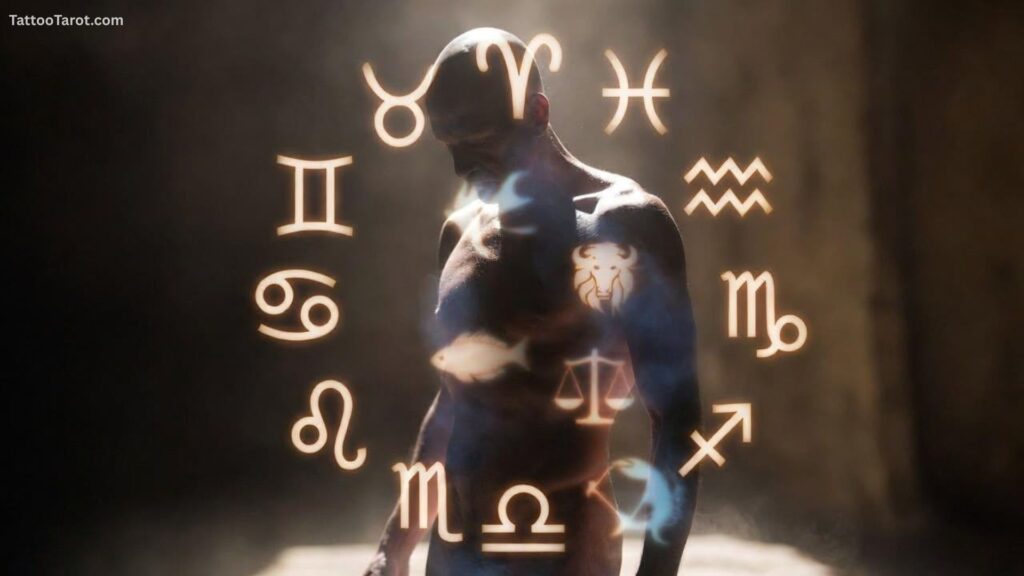
The Zodiac Man, or Homo signorum, is basically a diagram of a human body with zodiac signs mapped onto it. Leo = heart, Virgo = abdomen, Scorpio = reproductive organs, Pisces = feet. In the Middle Ages, doctors actually used these charts to decide when to operate, do bloodletting, or treat illnesses. Knee surgery? Wait for Capricorn. Headache? Do bloodletting during Aries. Yes, people actually did this.
By the 17th century, science caught up and this stuff faded, but the Zodiac Man is still around in old books, almanacs, even prayer books. He’s like a weird reminder that humans were once thought of as a small universe, connected to the big one above.
The Pythagorean Tetractys
Pythagoras didn’t just love triangles, he loved numbers in general. And he had this thing called the Tetractys: ten dots arranged in four rows, forming a triangle. Looks simple, but it was supposed to represent the order of the universe. Four dots = elements, three dots = harmony, two dots = duality, one dot = unity.
Some people think it influenced Kabbalah, where the Tree of Life also has ten points (or sefirot) representing stages from Earth to divine. The four-letter name of God, the Tetragrammaton, was sometimes shown in Tetractys form too.
Freemasons liked it a lot. William Preston, again, said swearing by the Tetractys was like taking the most sacred oath imaginable. Manly P. Hall, in the 1920s, also wrote about it at length, calling it “a symbol of the greatest importance” because it supposedly reveals the hidden structure of the universe. Basically, ten dots that say way more than ten dots should.
The Planetary Magic Square
Last one: magic squares. Numbers arranged in grids so every row, column, and diagonal adds up to the same thing. They’ve been around forever—in China by 190 BCE, India by 587 BCE, Europe via Arabic scholars during the Renaissance. But in the West, they became a kind of occult tool, used to summon planetary energies.
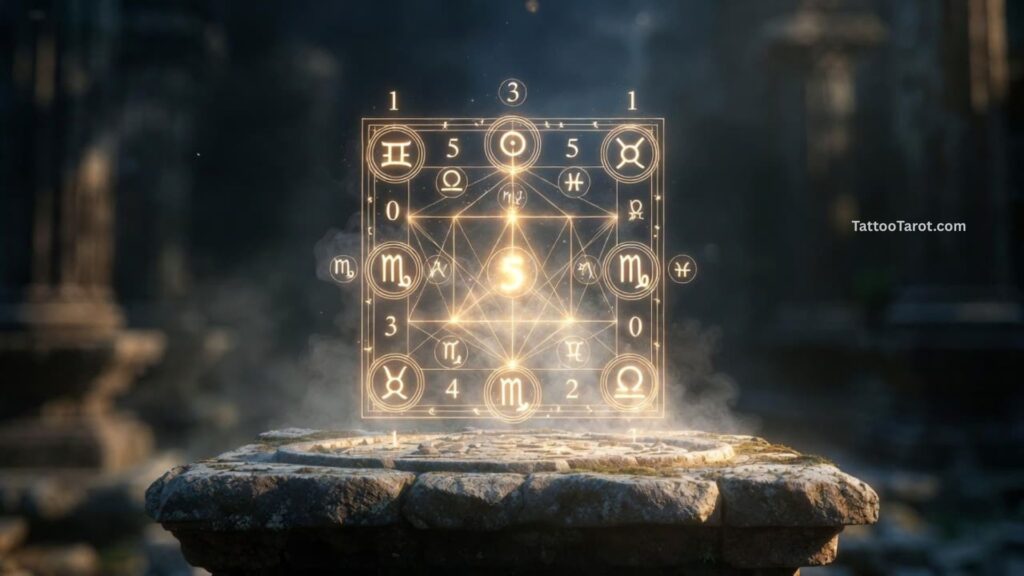
Each planet had its own grid. Saturn = 3×3, Mars = 5×5, etc. People put them on talismans to harness the planet’s energy. Heinrich Cornelius Agrippa, a 16th-century occultist, wrote stuff like, “All beauty is from Venus, all strength from Mars, and every planet rules, and disposeth that which is like to it.”
Albrecht Dürer’s Melencolia I (1514) is a perfect example. Behind a gloomy, brooding figure is a four-by-four magic square for Jupiter. The numbers add up to 34, meant to counter Saturn’s melancholy. Dürer even sneaked his initials and the year into the bottom row. Talk about multitasking—art, math, astrology, and secret symbolism all at once.
Why It Matters
All of these symbols—eye, ouroboros, Zodiac Man, Tetractys, magic squares—are basically people trying to understand the hidden patterns of the world. Some are spiritual, some alchemical, some cosmic, some mathematical. The thing is, they’ve lasted centuries because humans are curious, we want to see patterns, we want symbols to point to something bigger.
They’re not just decorations. They’re attempts to make sense of chaos, to find order, to encode knowledge so that only the careful observer might see it. And honestly? That’s kind of beautiful. Symbols hide things in plain sight, and if you pay attention, they start talking to you.
Conclusion
Uhh… so yeah, all these symbols, like the Eye, ouroboros, Zodiac Man, Tetractys, magic squares… basically people just trying to make sense of stuff. Life, death, the universe, stars, planets, all that crazy mysterious stuff. Humans have always been like, “Hmm, maybe if I draw a snake eating itself or put numbers in a grid, I can figure it out.” Weird, but kind of genius in a way.
And the thing is, these symbols aren’t just old boring stuff in dusty books or museums. You see them everywhere if you squint, like on money, buildings, art, even some random logos probably. They’re like… hidden hints or reminders that there’s more going on than what you see. Like, pay attention and maybe, just maybe, you’ll start noticing the same things people were trying to show hundreds of years ago.
Honestly, maybe that’s it. The symbols aren’t really teaching you something directly, they’re just… making you notice, think, wonder, get a little confused, maybe. They’re messy, kind of cryptic, kinda beautiful in a weird way. Maybe that’s what the occult always was—stuff hidden in plain sight, waiting for anyone curious enough to actually look at it.
Frequently Asked Questions (FAQs)
Q. What exactly does “occult” mean?
Ans: Uh, basically it just means “hidden” or “secret.” Stuff that’s not obvious, knowledge that’s kind of mysterious or only for people who dig deep enough. Think alchemy, astrology, weird symbols—stuff that’s more than meets the eye.
Q. Why are there so many symbols in the occult?
Ans: People like symbols because they’re like cheat codes for understanding life, the universe, or magic, I guess. Instead of writing a whole essay, they just draw a snake eating itself, a triangle, or a magic square, and boom—meaning is there if you know how to read it.
Q. The All-Seeing Eye… is that Illuminati stuff?
Ans: Eh, kind of? Kinda not. The Eye has been around for centuries, way before anyone started talking about conspiracies. Egyptians, Christians, Freemasons… it mostly just means “God/whatever sees everything.” The conspiracy stuff is just people reading too much into it later.
Q. The ouroboros looks creepy… what’s it supposed to mean?
Ans: Snake eating its own tail = endless cycles, life, death, rebirth, all that. Alchemists loved it because it represented the whole universe or the process of transformation. Modern artists even used it to say, “Even eternity gets messed up by time.”
Q. Zodiac Man? Was this for real medicine?
Ans: Surprisingly, yeah. People actually believed the stars ruled body parts. Knees = Capricorn, reproductive organs = Scorpio, etc. Medieval doctors used this when deciding when to do surgery or bloodletting. Weird, but it was science at the time.