Online tarot readings have exploded in popularity, mostly because they’re so easy to access. You don’t have to hunt down a mystic in a candle-lit shop anymore—you can tap a screen and get answers in seconds. But the big question everyone eventually runs into is: are these online tarot readings actually accurate, or are we all just fooling ourselves for convenience?
The honest answer lands somewhere in the middle. Some online readings are surprisingly insightful, especially if the platform uses skilled human tarot readers who actually understand symbolism, intuition, storytelling, and emotional guidance. Many people say the distance doesn’t water down the guidance at all—if anything, typing or video chatting helps them open up more than sitting across from a stranger.
But then there’s the other side: the automated “pick a card” generators. Those can be fun, but accuracy is hit-or-miss. A simple algorithm can’t read tone, emotions, or follow-up questions. It just pulls a random card and spits out a canned paragraph. That can still spark reflection, which is valuable, but it’s not exactly deep psychic insight.
The Rise of Online Tarot Readings
If you’ve spent more than two minutes online, you’ve seen how tarot has basically become a digital phenomenon. Pick-a-card readings, zodiac messages, “urgent timeless messages,” soulmate predictions, shadow work prompts—there’s so much of it that you could easily spend hours scrolling and never repeat the same reader twice.
Tarot has migrated everywhere: YouTube, TikTok, Instagram reels, even Reddit threads where strangers argue about card interpretations. And the wild thing is: none of this requires you to physically meet anyone. You don’t have to schedule an appointment or awkwardly sit across from someone while they stare into you like they can see into your soul. Instead, you can lie in bed at 1 a.m., watch a stranger shuffle cards on your phone screen, and convince yourself the Universe is “talking to you.”
The convenience is honestly a big part of the draw. TikTok is like the fast-food version of tarot—tiny, rapid, addictive messages. A video pops up with text like “Stop scrolling—this message is for YOU” and part of your brain lights up. You think: wow, what are the odds this video appeared right now? Even though the real answer is “the algorithm is creepy and tracks everything you do,” your emotional brain still feels like fate just knocked.
YouTube sits on the opposite end. You get long, slow-burn readings—20-minute to 2-hour videos. Readers offer multiple piles or objects to choose from so you can “intuitively pick” which message is yours. It creates this magic trick where you feel personally selected—even though thousands of other viewers are selecting the exact same pile.
But there’s another reason virtual tarot works so well: the content speaks to universal human stuff. Romance confusion. Career burnout. Identity crises. Heartbreak. Loneliness. Spiritual growth. The themes are broad enough that just about anyone can nod along.
Do online readings replace an in-person session where the reader looks at you and tunes into your specific energy? Probably not. But they open a low-effort doorway for people who are curious, skeptical, shy, or broke. And whether someone treats it like Netflix entertainment or soul-searching, tarot has definitely found its place in the internet ecosystem. There’s no denying the reach.
Also Read: Sacred Geometry Tattoo Meanings (Tattoo Meanings)
How Accurate Are Tarot Readings Online?
This is the million-dollar question:
When you scroll into a tarot reading online, how accurate can it really be?
Most online readings—especially viral ones—are extremely general. They have to be, otherwise they wouldn’t resonate with large audiences. So instead of a specific message like, “Your coworker Joe is stealing your stapler,” you get something like, “Someone around you is jealous of your success.”
Which applies to nearly everyone at some point.
There’s a psychological thing happening here called the Barnum effect—people naturally interpret vague statements as highly personal. Tarot online uses that all the time. So yes, part of the “accuracy” you feel may actually be your brain filling in the specifics.
But that doesn’t mean online tarot is fake across the board. Some readers are experienced, intuitive, thoughtful, and genuinely good at reading symbolic patterns. When someone like that posts a general reading and it happens to align with whatever emotional storm you’re living through, it feels shockingly accurate. There’s value in that reflection.
Then there are personalized online readings, where the tarot reader actually engages with your question—through email, live chat, Zoom, whatever. Those can be surprisingly close in depth to an in-person reading because at least the reader is focusing on your energy rather than the entire internet’s collective heartbreak.
Your mindset matters too. If you watch a tarot video while distracted, doom-scrolling, not really listening, you’re probably not going to find wisdom in it. But if you treat it like a meditation moment—sit still, listen, reflect—the message might hit differently. Accuracy isn’t always about prediction. Sometimes it’s about interpretation.
So no, online tarot won’t magically tell you the winning lottery numbers. But it can spark insight, help you think about your choices, or comfort you during confusing periods. Sometimes “accuracy” isn’t the point—clarity is.
How Accurate Are Zodiac Tarot Readings?
Zodiac tarot readings are their own online sub-genre. You’ve probably seen titles like:
- “Aries—Your soulmate is coming in September!”
- “Pisces—They regret losing you!”
- “Capricorn—Money breakthrough ahead!”
It’s fun, but there’s a built-in limitation: zodiac signs include millions of people. A Virgo reading isn’t tailored to you, it’s tailored to a stereotype—organized, anxious, critical, a little bit of a perfectionist. Readers pull tarot cards through the lens of those “Aries energy is bold and impatient!” archetypes.
Does that mean zodiac readings are useless? No. Sometimes the timing themes hit. Some readers know astrology deeply and can interpret tarot with enough nuance that it becomes thought-provoking. When a Virgo reading lines up eerily with your current job stress, it feels uncanny.
But if you want accuracy that’s deeper than “Your sun sign is emotional,” then you’d need a reading that includes your full chart—moon, rising, houses, transits. Most quick zodiac tarot content doesn’t offer that level of detail.
Approach zodiac tarot like a horoscope:
Use what sparks reflection, ignore the rest. Don’t panic because some random video said “Geminis will lose a friend this month.” Enjoy it, but don’t surrender your free will to it.
How Accurate Are Collective Tarot Readings?
Collective readings are like mass spiritual group chats. It’s one message aimed at everyone watching. The assumption is that “the collective” shares similar energetic themes—breakdowns, breakthroughs, Mercury retrograde meltdowns, etc.
Accuracy depends on alignment. If the collective message says:
“Many of you are leaving behind toxic dynamics,”
there’s a good chance a chunk of viewers are doing that, because humans across the world tend to deal with similar emotional cycles. But collective readings won’t capture specific details about your life.
They aren’t supposed to. The reader can’t see you, can’t hear you, can’t ask clarifying questions. You’re meant to take what resonates and drop the rest. The danger comes when people treat collective readings like prophecy instead of possibility.
Still, collective readings can create community. Knowing other people are struggling with similar themes—career shifts, emotional discomfort, loneliness—feels validating. They’re less about accuracy and more about emotional companionship.

Algorithms and Popularity in Online Tarot Readings
A reality check: the tarot you find online is sitting on top of algorithmic manipulation. TikTok and YouTube don’t push the best readers—they push whatever gets emotional reactions. Short, dramatic content thrives. Videos titled “The universe is screaming for your attention!” travel faster than videos titled “Here’s a nuanced tarot reflection on emotional boundaries.”
Eye-grabbing thumbnails, sensational love predictions, fear-based warnings—they drive gameplay. The algorithm rewards attention, not quality.
That means a thoughtful tarot reader who uploads slow, grounded, nuanced readings might sink under the radar. Meanwhile, a flashy reader promising soulmate reunions every week may go viral because it makes people hopeful. It’s not a fair system.
Also, creators feel pressure to publish constantly. Some readers pump out five readings a day to keep their numbers up. When quantity becomes the goal, accuracy and depth can drop—because tarot isn’t meant to be performed under algorithmic duress.
Understanding that dynamic helps you filter. If a reading feels like clickbait, that’s probably what it is.
Can TikTok Tarot Readings Predict Your Future?
TikTok tarot is fun—it’s like fortune-cookie roulette. But “predict your future” is a stretch. These are extremely short videos, usually less than a minute. You can’t dive into emotional trauma or long-term life patterns in 43 seconds with dramatic background music.
Most TikTok readings rely on universal hopes and fears:
- You’ll meet someone.
- You’ll leave something behind.
- You’re about to transform.
- Blessings are coming.
Those apply to everyone at some point. So TikTok doesn’t predict your future, but it can prompt your brain to think about your future. And honestly, that’s valuable in its own way.
Sometimes a TikTok reading about “new opportunities” makes you realize you’re craving change. Sometimes a reading about “letting go” encourages you to stop texting your ex. Tarot isn’t making those decisions—you are.
Treat TikTok tarot like creative journaling prompts, not prophecy.
Are YouTube Tarot Channels Reliable for In-Depth Insights?
Compared to TikTok, YouTube feels like grad-school tarot. Long videos. Slow explanations. Card clarifiers. Oracle decks stacked on tarot decks stacked on astrology transits. Some readers put in serious work. When you choose a pile based on intuition and the reading lines up with your emotional landscape, it feels wild.
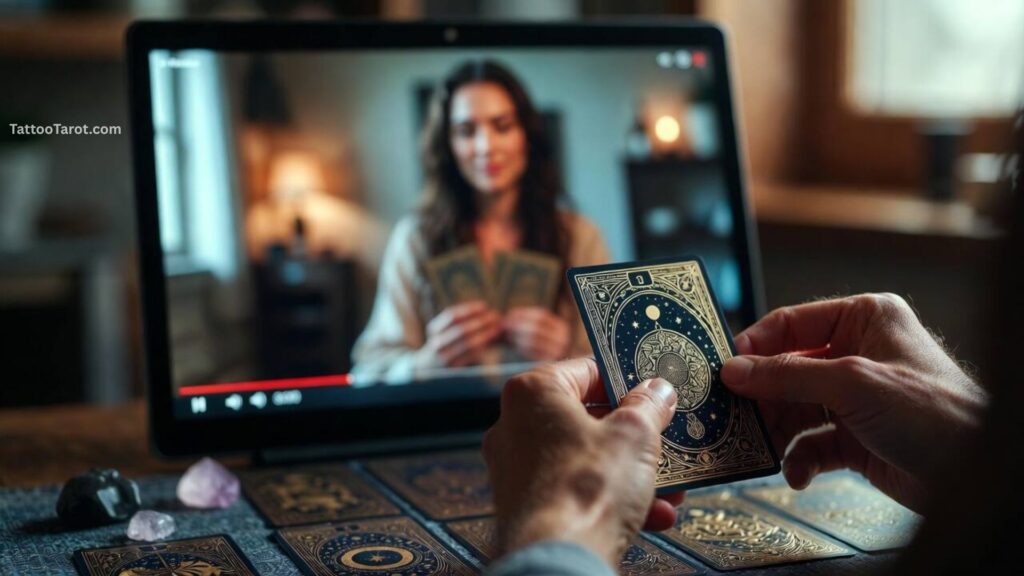
Pick-a-card readings encourage agency. You make a choice, so you feel “guided.” Even though thousands of other people also picked pile #2, the psychological imprint is: “I chose this. It’s my message.”
But again: YouTube readings aren’t designed for you individually. They’re still broad. Some parts will hit. Some parts won’t. That doesn’t make the reader bad—it just means tarot has limitations when scaled to an audience.
Reader skill matters too. Some YouTubers are deeply educated in symbolism, archetypes, trauma language, spiritual psychology. Others are basically tarot-themed theater. You’ll know the difference after watching awhile.
Think of YouTube tarot as:
- A reflective tool
- A way to externalize your thoughts
- A meditative experience
But if you want specific guidance, you still need a personal reading—online or in-person.
The Influence Of Personal Connection In Online Tarot Readings
Tarot at its core is relational. The card meanings matter, the intuition matters, but the energy exchange between reader and querent matters too. In-person readings include body language, emotional cues, nervous laughter, energy shifts. A reader can feel when a question hits a nerve.
Online sessions—live ones, at least—can still capture some of that. A reader can see your reactions, hear your voice, ask follow-ups, re-pull cards. It’s not identical to being in the same room, but it’s close enough for many people.
Pre-recorded content has none of that. You’re essentially borrowing someone else’s interpretation and trying to jam your life into it. It can work, but it’s not personal.
And your openness matters. If you sit down for a reading determined to “disprove” tarot, you’ll probably succeed. If you sit down determined to reflect and grow, you’ll get value from almost anything.
Online tarot can guide you, inspire you, soothe you—but if you need a laser-specific reading, you probably want an actual one-on-one setup.
Finding Accurate Online Tarot Readings on YouTube or TikTok
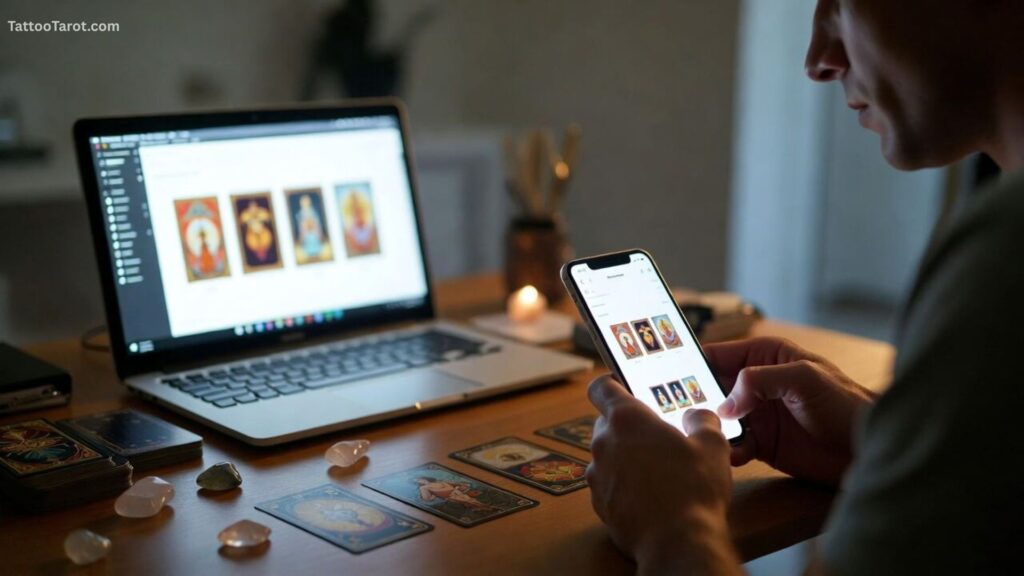
If You Want To Sift Through Tarot Chaos And Find Someone Good, Start With A Few Filters:
- Look for readers who explain symbolism rather than shouting predictions.
- Avoid readers who promise absolutes (“Guaranteed love in 10 days!”).
- Check how they talk about timing—good readers are cautious.
- Notice whether they encourage your choices versus telling you what to do.
- Scan their community—are viewers thinking, or worshipping?
Sometimes smaller channels are hidden gems because they’re not performing for the algorithm. They aren’t baiting you with soulmates and money miracles. They just read the cards.
Curate your experience. Don’t binge the same theme over and over hoping to hear a magical answer. Spread out. Explore tone. Keep your critical thinking hat on.
Avoiding Common Pitfalls of Online Tarot Readings
People get sucked into online tarot for emotional reasons—loneliness, heartbreak, anxiety about the future. That’s fine, but it makes you more vulnerable to sensational messages.
A few pitfalls to watch:
1. Treating vague messages like destiny.
If a video says “Someone from your past returns,” that could describe anyone’s life over a 6-month period.
2. Believing fear-based tarot.
Some creators prey on anxiety with messages like “They’re cheating!” or “Someone is cursing you!” That’s not spiritual insight—that’s emotional manipulation.
3. Using tarot instead of decision-making.
Tarot should support choices, not replace them. It’s not a life GPS.
4. Letting algorithms keep you stuck.
If you watch three love readings, TikTok will feed you fifty more. That loop can create emotional obsession.
The fix?
Use tarot as a mirror, not a commandment.
Takeaways: Are Online Tarot Readings Accurate?
Here’s the messy, honest answer:
Online Tarot Can Be Insightful—But Accuracy Is Conditional. It Depends On:
- The reader’s skill
- The format (personal vs general)
- The algorithms that surface content
- Your mindset
- Your emotional state
- Your willingness to reflect rather than surrender your agency
Personal readings—online or in person—will always be more accurate than collective or zodiac content. Algorithms reward performance, not depth. General readings rely on universal human themes. And tarot—no matter where it happens—isn’t about fortune-telling certainty. It’s about reflection, choice, and interpretation.
If you go into online tarot expecting prophecy, you’ll probably be disappointed.
But if you go in looking for perspective and emotional clarity, you might be surprised how much you get out of it.
Tarot doesn’t have to predict your future to be worthwhile. It just has to get you thinking.
Conclusion
In the end, tarot—online or not—is just a conversation with your own intuition. The cards aren’t there to run your life or make choices for you. They’re there to help you notice what you’re feeling, what’s shifting, and what you might want to rethink. Use what helps, ignore what feels pushy or fear-based, and let tarot support you—not control you.
FAQ: Online Tarot Readings
Q1. Do online tarot readings actually work?
Ans: They can, depending on what you’re expecting. If you want someone to predict lottery numbers or guarantee outcomes, you’ll probably be disappointed. If you use tarot as reflection—a way to explore feelings, choices, or patterns—online readings can be surprisingly helpful.
Q2. Why do those “This message is meant for you” videos feel so accurate?
Ans: Because they’re crafted to feel personal. They tap into universal experiences—love, anxiety, confusion—and your brain fills in the context. It’s not magic every time; sometimes it’s psychology mixed with decent intuition.
Q3. Are collective readings legit?
Ans: They’re legit as general guidance. They’re not going to know the specifics of your situation. Think of them like a horoscope—take what lands, ignore the rest.
Q4. What about zodiac tarot readings?
Ans: Fun, sometimes insightful, but extremely broad. Millions of people share your sun sign. If you want more detail, you’d need something based on your full chart or a personal reading.
Q5. Can someone on TikTok predict my future?
Ans: No one on Earth—or TikTok—can promise that. TikTok tarot is more like a spiritual snack. It might motivate you or comfort you, but it shouldn’t run your life.